Needless to say, that is a rude question. I cannot imagine posing that question to anyone. But I pose it here because it’s important to note that while it has always been a rude question, it has not always been rude for the same reasons. The word itself is derived, of course, from the ancient biblical city called “Sodom,” which was (as the story goes in Genesis 19) destroyed by “fire and brimstone” (yes, that’s really the language used in the King James Version of the story) as divine punishment for its “wickedness.” What kind of wickedness is the key issue, which has more contemporary relevance than we might at first imagine.
Interpreting ancient texts for a modern context is always challenging, a process that also exhibits a rich and complex history. An entire field of academic study emerged for that kind of analysis in the late twentieth century when scholars devoted deliberate attention to what is known as the “reception history of the Bible.” This field of study investigates and analyzes how particular passages of the Bible have been received in a particular community or society, and how those understandings shaped social trends and cultural artifacts. This field of study is not only widely multidisciplinary (sociology, economics, philosophy, art, among many others), it also traces the legacy of a certain strand of biblical interpretation in one context and how it makes an impact in a very different time and place. I appreciate that kind of historical analysis as a way to inspire my own proactive reading of our sacred texts—there isn’t just one meaning for a biblical passage that we must somehow discover; as people of faith, we are invited to make meaning from these texts, as every successive generation of Christians does in a wide range of places for a distinctive purposes.
So, are you a sodomite? If you think you know the answer, you might want to consult with the ancient Hebrew prophet Ezekiel. Most of us who have been shaped by modern Western society just assume that “sodomy” refers to a particular kind of sexual act—usually between men. But Ezekiel insists instead on a significantly different interpretation of that story from Genesis. Ezekiel portrays that ancient city as rife with social and economic injustice. “Now this,” he writes, “was the sin of your sister Sodom: She and her daughters were arrogant, overfed, and unconcerned; they did not help the poor and needy” (16:49). It seems to me that description ought to make all of us at least a bit uncomfortable—anyone who has fallen prey to arrogant posturing or refused to help the financially impoverished qualifies, in Ezekiel’s view, as a sodomite.
That focus on economics faded over time in Christian history (not coincidentally when the story was interpreted by affluent people). Justin Martyr in the second century used the story for anti-Jewish polemic. In the sixth century, Gregory the Great rather vaguely named Sodom’s flaw as “sins of the flesh.” And then finally, but not until the eleventh century, Peter Damian defined “sodomy” exclusively as same-sex sexual acts—and that definition reshaped the history of Western jurisprudence all the way to the U.S. Supreme Court in 2003 when they had to determine whether state “sodomy laws” were constitutional (they determined that such laws were not and overturned the remaining state statues to that effect).
This coming Sunday we will hear a passage from Matthew’s account of the Gospel in which Matthew’s Jesus makes a reference to the destruction of Sodom and Gomorrah. It just so happens that the lectionary assigned this passage during LGBTQ Pride Month, and I can just about guarantee that every LGBT person in the country who hears this gospel passage on Sunday will cringe, and for some, it will trigger a history of religious trauma. The story about the destruction of Sodom and Gomorrah has been used in some truly painful and heartbreaking ways to condemn gay and lesbian people, and sometimes quite violently. Just over a century ago, Oscar Wilde was accused of being a “sodomite” in 1895 London. He stood trial for this, accused of “public indecency,” went to prison with a sentence of hard labor, and as his sole surviving grandson has recently written, his two sons were raised to forget him and he died within a year of his release from prison, never to see his family again. All this based on a gross misinterpretation of an ancient biblical story.
I did a deep dive into some of this history for an essay that was later published in the Oxford Handbook of the Reception History of the Bible (2011). I chose to focus my attention on how the story in Genesis 19 has been received in the worldwide Anglican Communion and the way it has almost relentlessly been received through the lens of gender dominance. The modern world, in other words, has mostly understood “sodomy” to consist in the violation of gender roles for physical intimacy—it’s difficult to be clearer about that without being crude, but this means, basically, that a bodily sexual act is considered “proper” only when a man is penetrating and a woman is penetrated; sodomy violates that natural order by “treating a man like a woman.” As you might surmise, this mode of biblical interpretation is not only about gay men; it’s actually connected to the (ongoing) objection in some parts of the Anglican Communion to the ordination of women—to ordain a woman, in other words, is in effect a religious version of “sodomy.” (Click HERE for a PDF document of my essay in that Oxford handbook.)
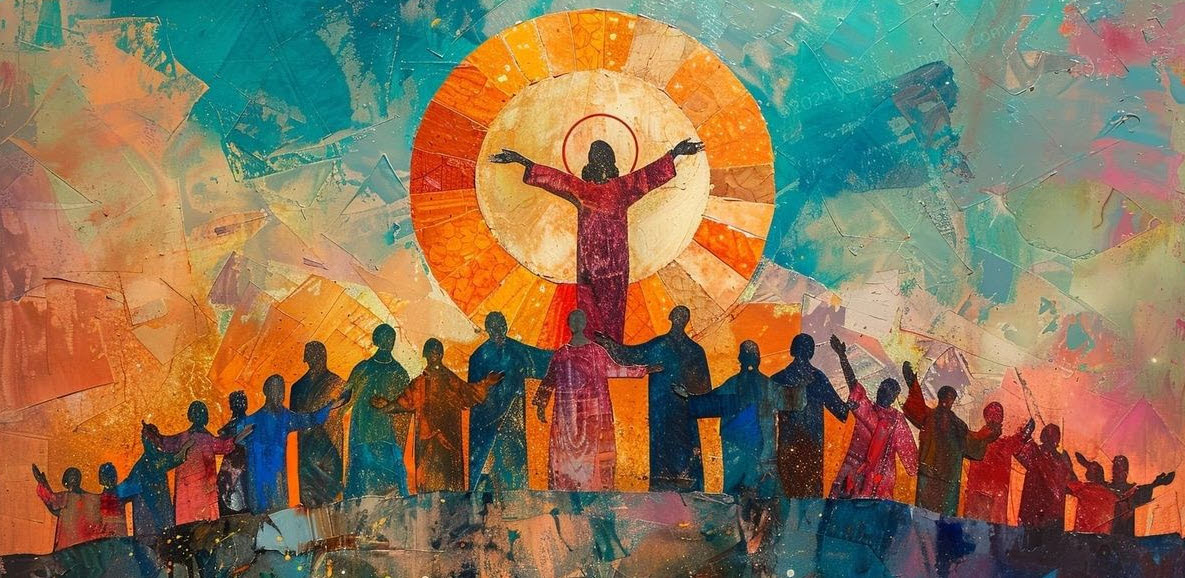
Rest assured, this is not what I’m preaching about on Sunday! But this backstory for the almost casual reference to Sodom and Gomorrah in this week’s Gospel reading matters for a richer and more robust appreciation of that passage: Jesus is sending his disciples out into the world on a shared and dangerous mission. The “sending” and the “mission” create the link to the story in Genesis19 where God sent angels to Sodom for a divine mission. There are several hair-raising components to this Gospel passage, not least is the sense of urgency and critical importance of the mission on which Jesus sends his friends, which Matthew tries to underscore by evoking that dramatic story from Genesis. (The image above, of Damon Powell’s painting of the Ascension of Jesus, strikes me as a reminder that, whatever else we want to make of the “ascension,” it was a sending of the disciples to continue to mission of Jesus.)
I worry at times that this beautiful lakeshore region can keep us from seeing a wider world that stands in desperate need of healing and profound, comprehensive change—everything from economics to ecology and from social norms to public policy. The urgency of Matthew’s Jesus is needed right here in Saugatuck as we consider how to cultivate a community of Gospel witness. As we gather on Sunday for the second week of Pride Month, how can we ensure that this parish offers a genuinely hospitable place for LGBTQ people, especially those who have been traumatized by religion, and what role can we play in changing a social order that continues to terrorize not only “queer” folk but also women generally? That’s the urgency of the mission on which God is sending us—right here, and right now.
Dates and Notices
- Scripture and Sexuality is a topic that tends to shape conversations (and sometimes confrontations) at LGBT Pride festivals. As people of faith, we should always be prepared to give sound religious and spiritual reasons for our unqualified embrace and welcome of LGBT people—including our approach to the Bible in that welcoming posture. This Sunday, June 14, following the 10:15 liturgy, we will review ways of talking about the Bible for the sake of welcoming LGBT people, including strategies for engaging with people who object to such postures of Gospel welcome. This will be framed with an approach to the reading the Bible overall, and if you can’t be here in person, it will be streamed and recorded on YouTube.
- A Rectory Reception is just the thing to help celebrate LGBTQ Pride Month and also greet some of our newer members and guests in these summer weeks. Please mark your calendars for Sunday, June 28—“Pride Sunday”!—and stop by the Rectory between 4:30—6:00 p.m. for some light refreshments and fellowship! (This will include vigorous welcome wiggles from River the Aussie shepherd dog…)
- The Bi-Annual Meeting and Picnic! Some years ago this parish began conducting a Bi-Annual Meeting in the summer to help ensure the full participation of “snow birds” who were away in January. We have kept that practice and we conduct some important business on that day, including the election of Vestry members and other lay leaders. This year we are adding a wonderful parish picnic to the agenda! Mark your calendars for Sunday, July 19. The meeting will happen immediately after the 10:15 liturgy and we will enjoy a picnic after the meeting!
- The Nominating Committee has been meeting to do their important work of leadership development and identifying people to serve in key positions as we continue together on this “good road” in this parish. As we prepare to hold elections at our Bi-Annual Meeting in July, do note these nominations:
-
- For Vestry: Larry Engel and Rita Davenport.
- For Diocesan Convention: Bobbie Gaunt and Julia Lamb.
- For Endowment Fund Trustees: Janet Eder
- For the Nominating Committee: Lisa Baker and Margaret Mason
Fr. Jay
A Community of Care
Please let us know how we may pray for you—concerns as well as celebrations—and other requests you may have as we strengthen our bonds of care and compassion with each other here in western Michigan and with those around the world in need of prayer.
Notices
We received word this week that Marjorie Wallendorf died peacefully in her home in Arizona and under hospice care. Please keep her sister, Abigail Collins, and her extended family in your prayers.
Prayer Requests
- The United States of America—for a restoration of peace and for a renewed commitment to the common good; for an end to systemic racism and violence; for social and economic justice; for a courageous engagement with ecological renewal and healing.
- For an end to violence and a lasting peace with justice throughout the world—in the Middle East (especially in Iran, the nations of the Gulf region, and still also Gaza and the West Bank), and in Ukraine.
- The mission and shared ministry of this parish, for pastoral insight and ministerial discernment for the clergy and lay leaders, especially the Vestry and our various Ministry Teams.
- For the Bishop Search Committee of this Diocese of the Great Lakes, for divine guidance in preparing a slate of candidates, and for discernment among all those who might feel called to serve.
- Lynn, Mary Ryder’s cousin.
- Katelyn, for comfort and healing.
- Holly Quarles, and her family, for courage and comfort.
- Mary Saba, for healing.
- Frank Lindsay, for healing.
- Sky and Dale Ann Suydam, for resilience and courage.
- Kevin Martin, for healing and renewed strength.
- Susan Gaunt, for renewed strength and healing.
- Ruth Vanden Bosch, for resilience and healing.
- Mike Mulcahy and Chris Seidel, for comfort and strength.
- Abigail Collins, grieving the loss of Marjorie Wallendorf.
Special Occasions in June
Do we have your special occasions on file? Would you like to prayerfully celebrate your baptismal anniversary? Ordination anniversary? Let us know what you would like us to remember with you and we’ll post it!
Birthdays – June
Bonnie VerWys 6/3, Don Olendorf 6/7, John Celletti 6/12, Eve Shetterly 6/15, Ellen Neal 6/16, Christi Allen 6/17, Marcy Elder 6/20, Abigail Collins 6/25, Marion Monique 6/28, Janet Eder 6/30
Wedding Anniversaries – June
Win and Mary Ryder 6/1, Larry Engel and Darren Schacht 6/13, John and Cynthia Fulenwider 6/24, David and Margaret Mason 6/29
Common Prayer for Shared Ministry
Notes on the Liturgy from Fr. Jay: Pride Month and Eucharistic Formation
LGBTQ Pride Month, Black History Month, and the Season of Creation, have become important markers for us in this parish for how our liturgical formation shapes us as bold witnesses to the Gospel in the wider world. While these three markers are distinct and enjoy their own integrity, they are also deeply and mutually informing—racial categories are always gendered, for example, and human sexuality is never generic but always inflected with ethnicity and cultural customs, and all of these play a vital role in how we think and act ecologically for the sake of life on this planet.
It’s both challenging and invigorating to keep such a big picture in view, all of which belong to an overall rubric that has guided my thinking about liturgy for many years now: Eucharistic formation for social transformation. How we pray makes a lasting impact on how we live, in other words, just as who we are shapes our experiences of the prayer and worship we offer. Our worship should be forming us as God’s people to live as bold witnesses to the transformative love of God—a love that remakes the world itself. We also live at a time when religion is treated with deep suspicion (and rightly so in some cases!) and we cannot simply assume any shared or self-evident meaning for our inherited traditions. All of this informs my weekly plunge into the lectionary texts, prayer book rubrics, liturgical options, and overall tone for the sermon. As we observe (and I hope also celebrate) LGBTQ Pride Month, I would invite us to attend carefully to how we are praying together on Sunday morning and how this can shape our shared witness to the Gospel—a witness to the healing presence of God in Christ through the power of the Spirit.