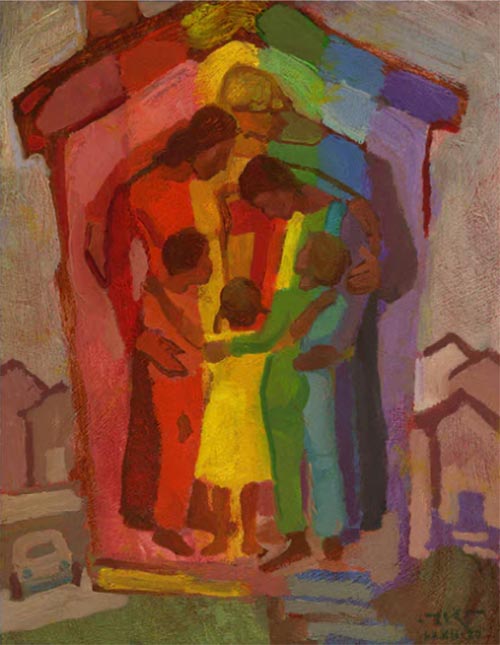
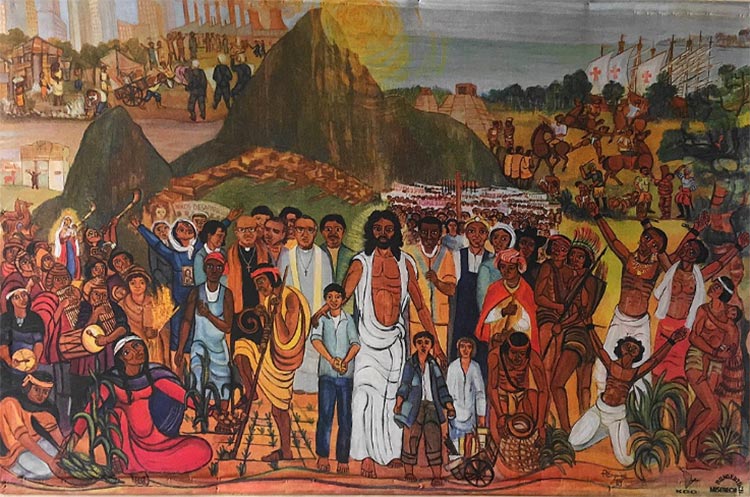
Every morning, River (my Australian shepherd companion) and I begin each day with prayer. When I grab my coffee and head to the study, she goes directly to the “prayer couch” and curls up for her post-breakfast nap while I pray. I’ve startled her a few times over the last couple of months with some gasps and heavy sighs while I read what the Daily Office Lectionary has been appointing for Morning Prayer, mostly the stories from Deuteronomy, Numbers, and Joshua about the conquest of Canaan by the ancient Israelites—these are cringe-worthy and gut-wrenching stories.
You may recall that narrative arc as the Israelites, after being liberated from slavery in Egypt, approach the land that God had promised to give them, but must then engage in battle with the peoples who are already living there. While I have read these stories many times over the years, I’m finding them especially brutal right now, perhaps because the world today seems filled with exactly that kind of violence and tribal hostility; it’s more than a little disconcerting to read biblical stories of conquest while the modern state of Israel engages in exactly the same thing in Gaza. (Please see the section below on the recent resolution passed by the General Synod of the Church of England concerning the ongoing devastation of Gaza by Israel.)
Quite honestly, I find it deeply dismaying that these stories of horrific violence are folded into the collection of our sacred texts. Just to be clear, “horrific” is not an exaggeration: consider the divine command to drive out seven nations and “destroy them utterly” and show no mercy (Deut. 7); or to cleanse the cities of those nations so that “nothing with breath remains alive” (Deut. 20); or how God even becomes angry with the Israelites, more than once, for not completely and utterly destroying everything in a conquered city (Joshua 7)—and that’s a short list. Reading these gruesome accounts again has resurfaced for me, in some fresh ways, a very longstanding concern among many about whether religion itself is inherently violent.
I will say in response to that provocative question, No, I do not believe religion itself is by definition violent, but not because of the scholarly and pious gymnastics that some use to excuse or just overlook the brutality of these biblical accounts of violent conquest. (One such scholar insists that these stories should simply confirm our disgust toward idolatry, which Israel’s violence was supposed to wipe out; another urges us to notice that these acts of violence resulted from a divine command and not mere human whim, as if we should find comfort in worshipping a monstrous God of vengeance.) Religion itself might not be inherently violent, but it is easily and often co-opted by political regimes and social movements as a way to justify domination, enslavement, colonization, and even genocide. The English Puritans were actually quite explicit about this when they imagined themselves as God’s “chosen people” on a “divine mission” to “conquer this new promised land” called America—and that divine command included both westward expansion and the violent erasure of the “Canaanites” already living here (indigenous peoples).
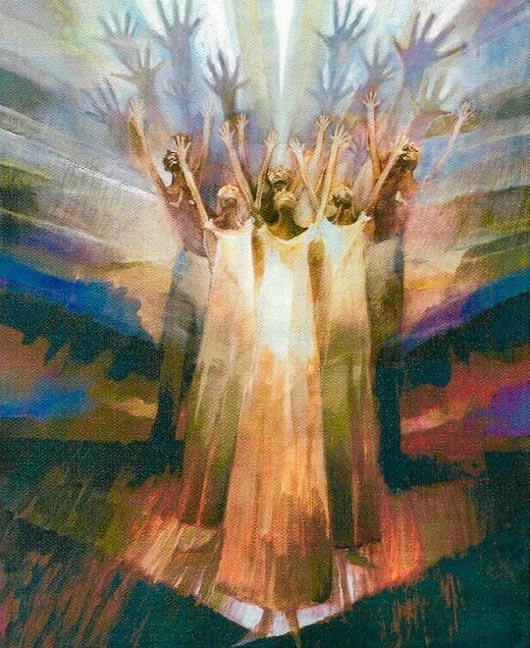
It’s quite easy to suppose that religion itself is the cause of these violent chapters in human history, but religious traditions are far more complex than that. Such complexity is actually enshrined in our sacred texts, which I always remember (with gratitude) when the lectionary assigns a portion from the ancient Hebrew prophet Isaiah, as it does this week (55:1-5). The expansive visions of this ancient prophet can feel exactly like the image used in this week’s selection: water for a thirsty soul, or a soothing balm in a violent world. Soothing, yes, but also perplexing given the competing strands of biblical storytelling.
Some biblical scholars, for example, would summarize the book of Deuteronomy as an account of how an ancient people made a covenant with a “warrior god,” a covenant that demands conquering and dominating all other nations and peoples, and with violence if necessary. But that’s not the only aspect of ancient Israelite history for us to notice in the Hebrew Bible: in contrast to the story of domination, the narrative and prophetic arc in Isaiah is one of “turning swords into plowshares,” inviting all the nations to God’s holy mountain where all shall learn war no more and enjoy the abundant life of peace. So, which of these visions about ancient Israel, both of which reside in our collection of sacred texts, do we wish to embrace as the truth?
One of the more difficult things I had to learn when leaving my Evangelical Christian background many years ago is realizing that the Bible does not tell us how to read it. There are no instructions in biblical texts about how to engage with its complexities and contradictions, or how to discern from sacred texts the kind of priorities we ought to adopt. We ourselves must decide how we’re going to read those ancient texts, and determine what criteria we will use to make meaning from them, and then test those decisions together in the way we live. That process of reading, interpreting, living, and testing makes a religious life of faith much more challenging, and involves much more emotional labor than simply opening a book and looking for instructions. We might also note that everyone brings personal assumptions, cultural biases, gendered preferences, political commitments, and a host of other factors to their reading and interpreting of biblical texts—this is true for everyone, even those who insist that they rely simply on the “plain sense” and “literal meaning” of the Bible—because there is no such thing.
Is religion inherently violent? No, but as religious people of faith, we have a serious and ongoing responsibility to counter the dangerous habit among far too many to make spiritual and religious traditions conform to their postures of hatred and programs of violence. We must remain vigilant about this regarding not only geo-politics, but also concerning race and ethnicity, sexuality and gender, and the many vulnerable ecosystems and other animals of this precious Earth. The stakes are high, indeed. But we are not without resources for this important witness; we are inspired and equipped to engage with that Gospel responsibility whenever we gather for worship around the Eucharistic Table, and as we receive there the bread of life and cup of salvation—God’s own transformative love. May we receive such love this week as Isaiah might imagine it: as water for every thirsty soul, and bread for every hungry heart.
Dates and Notices
- Honoring Ancestors: As a way to bridge an anticipated revenue gap in our budget, we’re inviting those who can to “sponsor a Sunday” and Honor Ancestors in this second half of the calendar year. Please see the section below on how you might “sponsor a Sunday” and honor your roots at the same time! This will be a wonderful way to lead up to our All Saints’ Day celebration on November 1.
- Outdoor Sanctuary: Worship seemed to flow well this past Sunday in our revised configuration “under the tents”! We will be back inside this week for both services, but be sure to note the schedule for worshipping our Outdoor Sanctuary. And do note that the 8:30 liturgy will always be inside, and we will notify everyone by email or text message if weather or air quality moves us back inside on a given Sunday.
- Preaching Schedule: One of the blessings of having the Rev. Rebekah Taylor among us as our “Missioner for Digital Ministry” is the gift of having her preach on occasion! Rebekah is now currently scheduled to preach on these Sundays: August 2, August 23, September 13, October 11, and October 18. We will also welcome J. Davey Gerhard as a guest preacher on August 16 (Davey is the executive directory of TENS, an organization that provides resources to parishes for stewardship and congregational development).
- Be Sure to Vote! While November is still just a bit more than three months away, you can actually cast your vote much sooner for various political offices! Early voting happens here in Saugatuck and Douglas from July 25—August 2, and from October 24—November 1. Given the importance of politics for the common good, voting really should be considered a spiritual discipline, and one that is engaged thoughtfully and prayerfully—be sure to vote, if not early, then on time!
A Community of Care
Please let us know how we may pray for you—concerns as well as celebrations—and other requests you may have as we strengthen our bonds of care and compassion with each other here in western Michigan and with those around the world in need of prayer.
Notices:
- George Gillespie (David Gillespie’s father and Deborah Gillespie’s father-in-law) is now in hospice care in Holland. This has been a difficult transition for George and certainly for David and Deborah; please keep all of them in prayer.
Prayer Requests
- The United States of America—for a restoration of peace and for a renewed commitment to the common good; for an end to systemic racism and violence; for social and economic justice; for a courageous engagement with ecological renewal and healing.
- For an end to violence and a lasting peace with justice throughout the world—in the Middle East (especially in Iran, the nations of the Gulf region, and still also Gaza and the West Bank), and in Ukraine.
- The leadership bodies of this Diocese of the Great Lakes, and for ongoing discernment in the process toward electing our first bishop.
- The mission and shared ministry of this parish, for pastoral insight and ministerial discernment for the clergy and lay leaders, especially the Vestry and our various Ministry Teams.
- Katelyn, for comfort and healing.
- Mary Saba, for resilience and courage.
- Frank Lindsay, for healing.
- Sky and Dale Ann Suydam, for resilience and courage.
- Kevin Martin, for healing and renewed strength.
- Susan Gaunt, for renewed strength and healing.
- Ruth Vanden Bosch, for resilience and healing.
- Mike Mulcahy and Chris Seidel, for comfort and strength.
Special Occasions in July
Do we have your special occasions on file? Would you like to prayerfully celebrate your baptismal anniversary? Ordination anniversary? Let us know what you would like us to remember with you and we’ll post it!
Birthdays – July
Matt Jackson 7/18, Rose Meengs 7/23, Stephen Baker 7/24, Vicki Berghuis 7/25, Cynthia Sorensen 7/26
Wedding Anniversaries – July
James and Julia Lamb 7/8, Francis and Vicki Berghuis 7/24
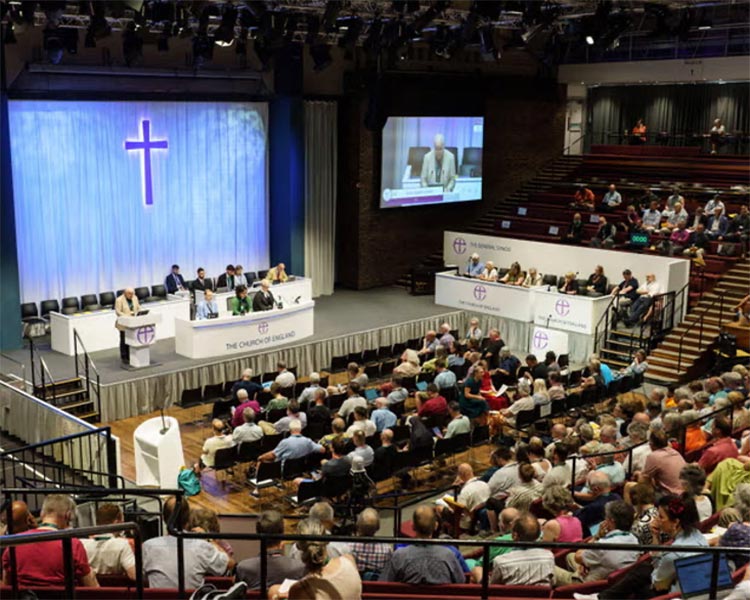
The “Carlisle Motion” and the Devastation of Gaza
Some observations from Fr. Jay about
State-Sponsored Violence and Gospel Values
The General Synod of the Church of England (equivalent governing body to our own General Convention in The Episcopal Church) just recently passed the “Carlisle Motion,” which is a significant decision to adopt a posture of solidarity with Palestinians in their ongoing struggle to survive in occupied territories and also to recover (if this is even possible) from the destruction of Gaza by the state of Israel. Christian communities continue to be quite rightly concerned about the long history of Christian anti-Semitism as we seek to respond to the horrific violence that has been ongoing in the Middle East for quite some time. It’s vital and urgent to keep this in mind: opposing the violent policies of the State of Israel is not anti-Semitic; to the contrary, it is a posture of compassion and humanitarian care, and for Christians, it’s a matter of Gospel values.
There is a history behind the latest decision by the synod, a history of a series of resolutions and statements that seek to walk this difficult but important path of denouncing violence against Palestinians while also avoiding anti-Semitic rhetoric. But let’s be perfectly clear about the level of violence in Gaza, which has not abetted hardly at all since the so-called “cease fire” went into effect some months ago. The “Kairos II” document issued by the Palestinian-Christian Initiative of the Church of England late last year notes what kind of violence this entails:
The war in Gaza “has left behind hundreds of thousands of martyrs and wounded, and nearly two million displaced people. Many were buried beneath the rubble, burned alive, tortured to death in prisons or forcibly displaced more than once. Others endured starvation, targeted even as they ran in search of food. Tens of thousands of children were killed in the most horrific ways. Gaza’s health, education, economic, and environmental sectors — indeed, every component of life — have been destroyed.” As that document also notes, every international tribunal and court that has considered this matter (except in the United States) has concluded that the State of Israel has been engaged in deliberate genocide in both Gaza and the West Bank.
The Church of England’s “Carlisle Motion” is an important move in the direction of solidarity in the midst of this heartbreaking situation. I would encourage you to read the motion and also to read the recent statement by the Bishop of the Episcopal Diocese of New York and the Episcopal Divinity School concerning that motion. Please also consider prayerfully contacting your political representatives in Congress to end military and financial support for the State of Israel. And please pray whole-heartedly for an end to the violence, for peace with justice, and for healing.