One of my mentors in seminary, Louis Weil, was fond of repeating a key benchmark for parish ministry: “keep the main thing the main thing.” But which “main thing” was he referring to? Or is there only one? Those who know me even just a little bit will surely guess that the “main thing” I almost always have in mind is the Eucharistic Table and our formation as God’s people at that table. Louis would quickly agree, and he might then add (likely with a twinkle in his eye), “don’t forget the other main thing—baptism.”
Taken together, Baptism and Eucharist, or “font and table,” are at the very heart of the Christian process of formation for our shared witness to the Gospel in the world. Receiving Holy Communion every Sunday in worship keeps our Eucharistic formation in mind, but we aren’t baptized every week, which sometimes makes it difficult to remember how important that sacrament of covenantal initiation is for Christian life. That’s why, roughly three or four times a year, we renew the promises of our baptismal covenant during worship. In this parish, we also practice an “open table,” which means that everyone is welcome to receive the Eucharistic elements of Communion without any conditions or prerequisites, including baptism. I am convinced that extending this clear and explicit welcome to the table for all people—no exceptions—is a vital and indispensable aspect of our witness to the Gospel of Jesus Christ in today’s world. I feel confident Louis would agree…and, still, what about baptism?
I’ve been reflecting just recently, and in some particular ways, on the significance of baptismal formation, mostly because of the excerpts we’ve been hearing from St. Paul’s letter to the Romans on Sunday mornings. The portions assigned by the lectionary for last week and this week come from the pivotal sixth chapter of that letter in which Paul articulates what eventually became the foundational understanding of baptism in Christian traditions. In brief, baptism signifies dying with Christ so that we might also rise with him into new life. This section of the letter to the Romans—which leads into the stunning and poetic exposition of Christian hope in the eighth chapter—stresses the significance of dying. Last week, for example, Paul argued that our “old self” is actually crucified with Christ so that a “new self” might then rise from those baptismal waters. Reflect on that for a moment: Paul proposes here a rather dramatic performance of identifying with the dying and rising of Christ. Remember, this is a “rite of initiation”—do you know of any other organization in which you have to die first before becoming a member? As Louis would say, don’t forget the “other main thing.”
Paul’s baptismal drama is of course rooted in the dynamics of first-century life. But we might link that ancient context to our own day by noting the powerful cultural and political forces that shape us to think and act in particular ways, both in that ancient context and today. We are shaped, or formed, to think about the world and about other people and also ourselves in ways that can quite often stand in opposition to the abundant life that Creator God intends for the whole creation. That old self must die and make room for a new self to rise, and with it, the commitment to work for the thriving of all. That “new self” is nothing less than the Body of Christ in the world, of which we are all living members by virtue of our baptism.
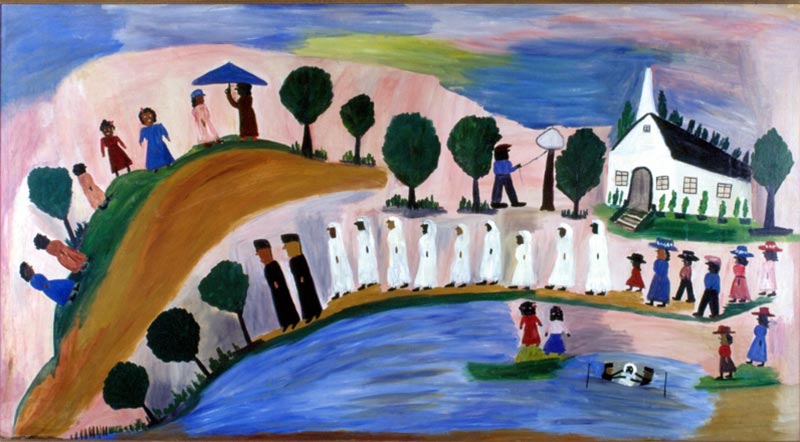
(I can’t help but return once again to the simple but moving paintings of Clementine Hunter, the self-taught artist who lived and died on a plantation in Louisiana. The image above is one of several about baptism in the rural part of the deep south, and a wonderful visual reminder that Christian baptism was invariably understood by Black faith communities as God’s promise of liberation—emancipation—from the ravages of white supremacy.
The way I’m writing here and inviting us to think about baptism can easily sound rather esoteric and abstract. But Paul (and Clementine Hunter!) had some very practical and concrete situations in mind to which this kind of baptismal formation makes a significant difference. Overall, Paul was concerned that the Christian church itself, as the Body of Christ in the world, should adopt a grace-filled hospitality that welcomes both friend and stranger; this is putting the matter rather mildly given the revolutionary shift in religious sensibilities marked by the inclusion of Gentiles in the early Jewish-Jesus movement—and on that decisive act of welcome, Paul argued, the Gospel itself depends. In that sense, an authentic, and therefore life-changing welcome, does indeed require a kind of death to the old self, both in the first-century world of Paul and in our own twenty-first century world today. Most of us are so accustomed to gathering with people who are mostly just like us that we can easily forget the challenge of extending a fulsome hospitality to those who are significantly different from us. Yet this welcoming posture is at the very heart of the Gospel of Jesus Christ, in whom God welcomes each of us unconditionally, and always with an endless, deathless love.
It just so happens that the short but powerful passage that we will hear from Matthew’s account of the Gospel on Sunday underscores the importance of this hospitable posture. Whoever welcomes you, Jesus says to his disciples, welcomes me. And those who welcome me, he says, welcome the one who sent me. As we extend a welcome to others we are, in that hospitable act, inviting them to encounter the presence of Christ in us, the very presence of God.
Given all this, we should never take for granted the ongoing vigilance and devotion it takes to cultivate a community that is genuinely welcoming. This is much more important in our witness to the Gospel than we might sometimes realize. In this LGBTQ Pride Month, for example, let’s remember that authentic hospitality, especially in a religious community, can be lifesaving for those who have experienced rejection or even violence because of who they are. The healing energies of a loving embrace—a word of welcome—is exactly the kind of new life to which we rise together as a community of the baptized.
Dates and Notices
- All Saints’ Outdoor Sanctuary is a wonderful spot for Sunday worship as a way to “lower barriers to entry” in the wider community (people will sometimes stop on the street as they pass by during worship) and to embody our commitment to ecological healing and renewal, not to mention to remind ourselves of the many other species with whom we share this precious Earth (the birds singing and occasional acorn-throwing squirrel are vivid reminders). Weather and air quality don’t always cooperate, of course, and the mulched land is sometimes not easy to navigate, so we have developed a schedule for our outdoor worship over these summer weeks. Please note: the 8:30 liturgy will always be inside and we will send text and email messages on Saturday afternoons if a planned outdoor service is moving back inside.
- A Rectory Reception is just the thing to help conclude our celebration of LGBTQ Pride Month! This Sunday, June 28—“Pride Sunday”!—please do stop by the Rectory between 4:30—6:00 p.m. for some light refreshments and fellowship! (This will include vigorous welcome wiggles from River the Aussie shepherd dog…)
- The Bi-Annual Meeting and Picnic! Some years ago this parish began conducting a Bi-Annual Meeting in the summer to help ensure the full participation of “snow birds” who were away in January. We have kept that practice and we conduct some important business on that day, including the election of Vestry members and other lay leaders. This year we are adding a wonderful parish picnic to the agenda! Mark your calendars for Sunday, July 19. The meeting will happen immediately after the 10:15 liturgy and we will enjoy a picnic after the meeting!
- The Nominating Committee has been meeting to do their important work of leadership development and identifying people to serve in key positions as we continue together on this “good road” in this parish. As we prepare to hold elections at our Bi-Annual Meeting in July, do note these nominations:
- For Vestry: Larry Engel and Rita Davenport.
- For Diocesan Convention: Bobbie Gaunt and Julia Lamb.
- For Endowment Fund Trustees: Janet Eder and Mary Ryder
- For the Nominating Committee: Lisa Baker and Margaret Mason
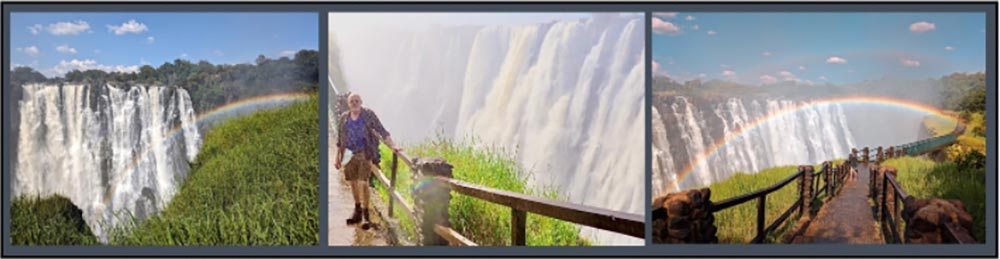
Writing about baptism, and especially about baptismal formation for a transformed way of life, I was reminded of my continuing education trip to southern Africa a couple of years ago. Toward the end of that trip, our group spent some time at Victoria Falls, on the Zambia side in Livingstone. We spent an afternoon hiking the trails that surrounded that breathtaking slice of countryside, and it included a very wet pathway next to the gorge carved by the water. The day was hot, with clear blue skies—and we were drenched. It was like walking through a rainstorm while standing in bright sunshine (see the photos below—that’s me in the middle one). That pathway—soaked in water, glistening in light, and surrounded by rainbows—is the perfect image for baptismal formation, the “good road” we travel as members of the Body of Christ. We walk together, constantly dripping with the waters of new life, seeking always to extend a welcoming embrace to others. May it be so…
Fr. Jay
A Community of Care
Please let us know how we may pray for you—concerns as well as celebrations—and other requests you may have as we strengthen our bonds of care and compassion with each other here in western Michigan and with those around the world in need of prayer.
Notices:
- We have been praying for Mary Ryder’s cousin Lynn for some time now. We received word last week that she had died after a long battle with cancer. Please keep Mary and her extended family in your prayers.
Prayer Requests
- The United States of America—for a restoration of peace and for a renewed commitment to the common good; for an end to systemic racism and violence; for social and economic justice; for a courageous engagement with ecological renewal and healing.
- For an end to violence and a lasting peace with justice throughout the world—in the Middle East (especially in Iran, the nations of the Gulf region, and still also Gaza and the West Bank), and in Ukraine.
- The mission and shared ministry of this parish, for pastoral insight and ministerial discernment for the clergy and lay leaders, especially the Vestry and our various Ministry Teams.
- For the Bishop Search Committee of this Diocese of the Great Lakes, for divine guidance in preparing a slate of candidates, and for discernment among all those who might feel called to serve.
- Katelyn, for comfort and healing.
- Mary Saba, for healing.
- Frank Lindsay, for healing.
- Sky and Dale Ann Suydam, for resilience and courage.
- Kevin Martin, for healing and renewed strength.
- Susan Gaunt, for renewed strength and healing.
- Ruth Vanden Bosch, for resilience and healing.
- Mike Mulcahy and Chris Seidel, for comfort and strength.
- Stephan and Maxwell and all those grieving the loss of Holly Quarles.
Special Occasions in June
Do we have your special occasions on file? Would you like to prayerfully celebrate your baptismal anniversary? Ordination anniversary? Let us know what you would like us to remember with you and we’ll post it!
Birthdays – June
Bonnie VerWys 6/3, Don Olendorf 6/7, John Celletti 6/12, Eve Shetterly 6/15, Ellen Neal 6/16, Christi Allen 6/17, Marcy Elder 6/20, Abigail Collins 6/25, Marion Monique 6/28, Janet Eder 6/30
Wedding Anniversaries – June
Win and Mary Ryder 6/1, Larry Engel and Darren Schacht 6/13, John and Cynthia Fulenwider 6/24, David and Margaret Mason 6/29