Rector’s Reflections
The Rev. Dr. Jay Emerson Johnson
The days grow shorter while the evening shadows lengthen, and even the biblical texts assigned for Sunday mornings start to reflect this seasonal shift as the planet tilts once more into autumn. We are switching back into the regular lectionary cycle for Sunday worship after our five weeks of the Season of Creation, and the texts actually startled me when I read through them on Monday. All of the texts, even the familiar Twenty-Third Psalm, carries an imprint of an eschatological Christian faith. That wonderful Greek word—eschatology—means both simply and profoundly “last things.” The notion of “last” here refers to ultimate and final things, like death and judgment, heaven and hell. Some brands of Christianity are more steeped in eschatological themes than others (I grew up in one of those apocalyptic traditions that featured more than only those four last things, and included ominous signs about the coming Antichrist, the Battle of Armageddon, the Rapture and the seven-year Great Tribulation). Christian eschatology made such an impression on me growing up (including some sleepless nights and more than a few nightmares) that I decided to focus on that branch of Christian theology in my doctoral program.
Rather than merely dismissing it or being haunted by it, I have come to appreciate over the years the inherently eschatological character of Christian faith. As one of my theological inspirations, Jürgen Moltlman, argued, “from first to last, and not merely in epilogue, Christianity is eschatology, is hope, forward looking and forward moving, and therefore also revolutionizing and transforming the present.” For Moltmann, Christian faith does not transfer hope over a far distant horizon or in some other world; the Christian Gospel never lets Christian communities rest satisfied with the cultural status quo, or how things presently stand, either in our own lives or in the world around us. Christians are perpetually restless, in other words, eager for a transformation of this world for the sake of the flourishing of all—certainly for an end to violence and for a blossoming of justice in a world of peace. That’s the kind of bracing and vibrant hope that we will start hearing about in the biblical texts assigned for Sunday mornings as this long season of Pentecost winds down and leads us into Advent, which is perhaps the quintessentially eschatological season of the year (and thus, quite honestly, my favorite).
One of those texts for this coming Sunday (from St. Paul’s letter to the Philippians) offers one of the most concise biblical summaries of an eschatological Christian faith: “The Lord is near.” The apocalyptic faith of my youth understood that to mean the nearness of the “Second Coming” of Christ and the so-called end of the world. Paul likely meant something similar, but that short declaration can be understood in a variety of ways. After all, at the heart of Gospel reassurance is exactly this notion that the Lord is always near to each of us and to everyone. We might combine that reassurance with the wonderful passage from the ancient Hebrew prophet Isaiah, also assigned for this coming Sunday. God, Isaiah declares, will one day wipe all the tears from our eyes. And, of course, the iconic psalm on Sunday reminds us that God will indeed shepherd us as we “walk through valley of the shadow of death.”
Here in the Northern Hemisphere, it is no mere coincidence that we observe and celebrate the vast Communion of Saints to which we all belong exactly when leaves are falling from trees, a chill is in the air, and the sun glides across a more distant southern sky. Our “Feast of Title” in this parish, All Saints’ Day, is a wonderfully “thin” time of year, as some would say, when the veil between this world and the next, between the living and the dead, is the thinnest. All Saints’ (November 1) and All Souls’ (November 2) invite a genuinely eschatological observance, not marked by mourning or with grief but rather with loving remembrance and a robust hope in the God of life. Memory and hope—these are the signature elements of our Eucharistic worship as we remember the death of Jesus every week with a declaration of an Easter hope.
So, let’s gather in the weeks to come with spirits lifted and our candles trimmed ready for light! And in these shorter days with lengthening shadows, let’s reassure each other that the Lord is indeed near to each of us, ready to wipe the many tears from our faces. We might even do that for each other as a sign of our deeply held faith in the loving God of life who is always with us.
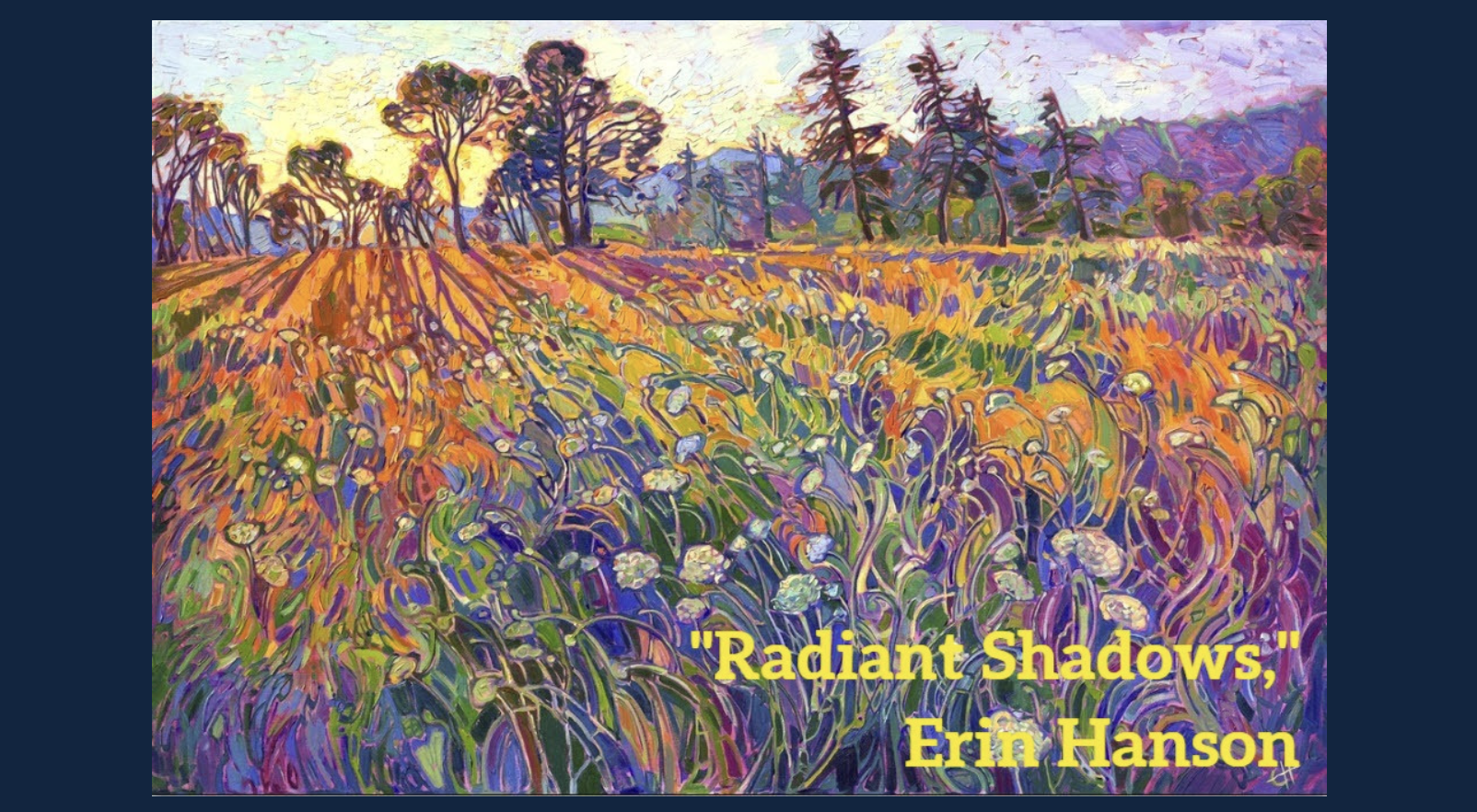
Featured Visual Artist: Erin Hanson
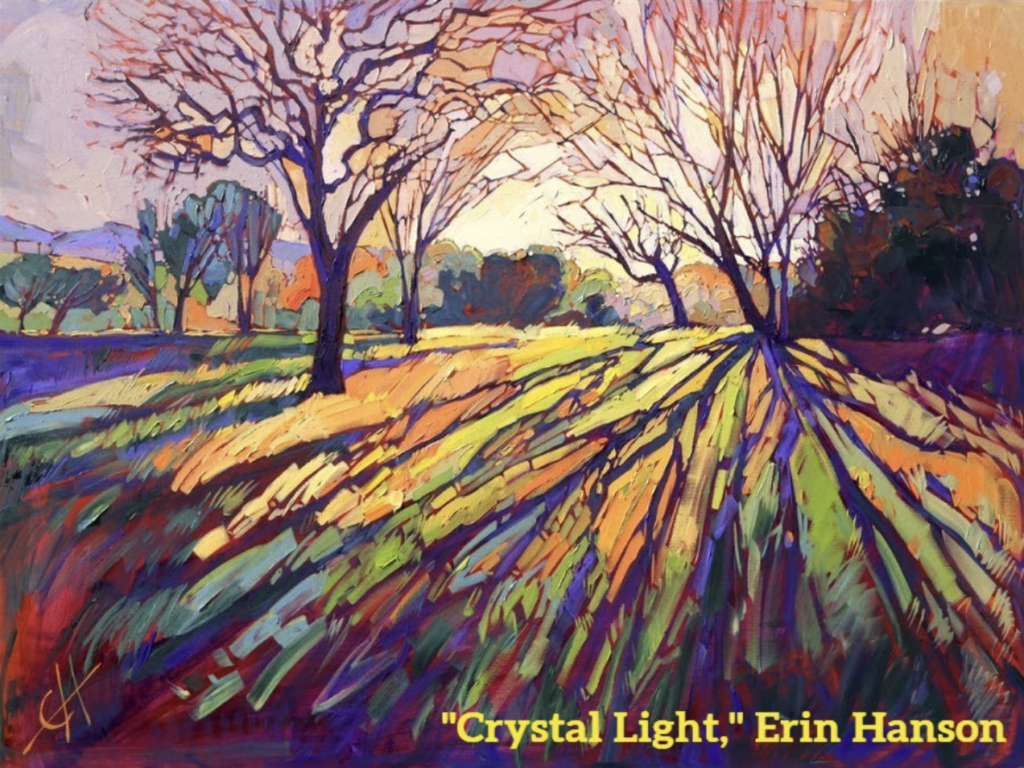 Erin Hanson’s artwork has appeared occasionally in the liturgy leaflets and newsletters of this parish. She is the creator of the painting style known as “open impressionism,” a vibrant and expressive painting technique that is being taught in hundreds of art schools. Her unique approach to oil painting has gained her millions of followers online and thousands of collectors worldwide. Erin’s goal as an artist is to inspire a new renaissance of impressionism in the contemporary art world.
Erin began painting in oils when she was eight years old. As a teenager, she apprenticed at a mural studio where she helped to paint 40-foot-tall murals while selling art commissions on the side. As a young girl, she found inspiration in the works of van Gogh and Monet, marveling at the way they transformed everyday objects into luminous harmonies of color and light.
In Erin’s words: “My goal is to capture the beauty of light during the golden hour and transform ordinary landscapes into extraordinary mosaics of color and texture. I apply oil paints in thick, expressive brushstrokes laid side-by-side, without blending, in the style I coined Open Impressionism. My goal for each painting is to capture a moment in time so beautiful it makes you catch your breath when you see it. I want my paintings to speak to you again and again, drawing you in, igniting a sense of joy every time you look at them.”