Nourishing the Roots of
Our Religious Faith
Rector’s Reflections
The Rev. Dr. Jay Emerson Johnson
Regardless of what you may happen to think of the policy positions of James Talarico, a candidate for U.S. Senate in Texas (and also a seminarian studying for ordination in the Presbyterian Church), it’s quite striking to him punctuate his public appearances with verses from the Bible and exhortations about the teachings of Jesus. He does this to remind his listeners that biblical writers frequently urge a posture of welcome and care toward the most vulnerable, the persecuted, the stranger, and the oppressed. We may differ, in other words, on matters concerning “sound economic policy” but if the Bible is in any way our guide, economic justice must be a priority. Talarico’s reliance on the Bible can in turn remind us as Episcopalians that The Book of Common Prayer is thoroughly embedded in biblical texts, images, phrases, and themes. The baptismal vows, for example, to work for justice and peace, and to respect the dignity of every human being are shorthand summaries of key biblical markers of a lively faith.
I mention all this because we live in an era of significant skepticism about religion generally and certainly about the Bible in particular. And there are good reasons for this, not least, are badly behaved religious leaders and the exclusionary practices of some churches. That’s why we must never take for granted the importance of genuine hospitality, and we need always to engage proactively with the Bible and our theological traditions. I devote a great deal of my time to this kind of work as we seek, together, to discern what kind of meaning to make from our religious traditions for our own day and for the wider community. Every generation of Christians has undertaken this kind of active engagement with biblical interpretation, leaving us a rich legacy of many different ways to read our sacred texts and to form our communities for Gospel witness.
This process of active engagement with our traditions is certainly multilayered and often complex. Sometimes, for example, biblical writers interpret each other and expand on themes found in other parts of the Bible; in effect, the Bible occasionally interprets itself! Consider, for example, the several layers of citation and interpretation that unfold in what the lectionary has assigned for this coming Sunday. We will hear a short passage from Leviticus, a book of laws, regulations, and ordinances. The excerpt concludes with this classic instruction to the people of Israel: “love your neighbor as yourself.” We will hear that instruction again from Matthew’s account of the Gospel on Sunday. Matthew sets the stage and context for this passage by noting that one of the Judean religious leaders, a specialist in religious law, puts Jesus to the test, as if trying to discredit his religious authority. “What is the greatest commandment?” he asks. And Jesus replies, first, by quoting from Deuteronomy—you shall love God with all your heart—and then by quoting that excerpt from Leviticus—you shall love your neighbor as yourself.
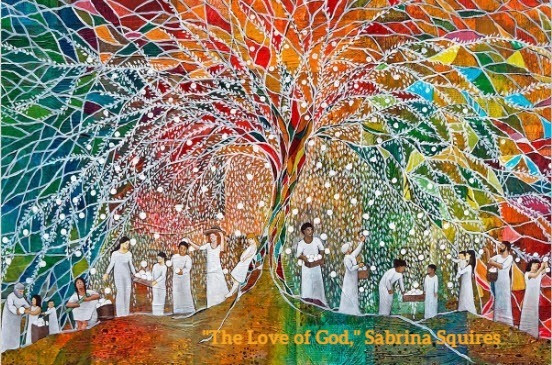
It’s important to note that Jesus is not merely reciting a rote or predetermined answer from ancient texts. He is instead connecting two commandments for the sake of a novel response. Both of those commandments are certainly featured in the texts of ancient Israel, but the precision with which Jesus combines them yields fresh insights about religion itself: the essence of religious faith is simply and profoundly love, and this love must be for both God and other humans, our neighbors (although I have used the image above before, by Sabrina Squires, I frequently return to her depiction of divine love as a tree, its fruit, the community gathered at the tree, and all of it woven together in a single “fabric” of love). Needless to say, all of this in turn provokes a series of questions about what love really entails and exactly who qualifies as a “neighbor.” (Concerning that last query, Luke has Jesus respond by telling the parable of the “good Samaritan,” suggesting that “neighbors” are not just the people closest to us or the ones we happen to like but most importantly those with whom we disagree or even actively dislike.)
A whole range of important insights emerge from the lectionary texts this week concerning love, but I want us to notice something a bit more broadly about the process of biblical interpretation that I just evoked. Notice how Matthew tells the story: Jesus does not merely quote from an ancient text in response to an important religious question; just as every rabbi, priest, and theologian has always done, Matthew’s Jesus sifts and sorts through sacred texts to build on religious insights of the past rather than just repeating them. That’s exactly what our lives of faith ask from us today. The drafters of the Prayer Book drew from centuries of liturgical traditions, and the lectionary compilers organized various historical patterns of readings, and when we gather for worship we do not merely recite and repeat all these texts—we are invited to make meaning from them for own day—and likely in ways that the Prayer Book drafters and lectionary sources would not have imagined—and I take that invitation seriously every week as I assemble materials for our liturgies and in my sermon preparation.
The long history of religious traditions, including Christianity, is a history of struggle and study, of confusion and confidence, of life-changing insight and institutional failures. Religion is, in other words, a human endeavor with both limited perspectives and breathtaking moments of beauty—and all of that complexity becomes the context for divine encounter. God meets us in the midst of messy human communities to help us stay on the good road toward flourishing, not apart from all the tragedies and triumphs of human life but embedded in them and bearing witness to the Gospel for them.
Needless to say, this “road” we travel is rarely if ever smoothly paved or without any potholes or hairpin turns. That’s why we must travel this road together, offering each other caring compassion and encouragement, as well as insights and inspirations. Having just launched our 2027 stewardship campaign this past Sunday, I am profoundly grateful to be traveling this road with everyone associated with this wonderful parish dedicated to all the saints—and that includes each and every one of us.
The Art of Faith
Planted here along the “Arts Coast” of Michigan, All Saints’ Parish turns often to the visual, literary, and performing arts as resources for our lives of faith and to enhance our social impact for a better world. As creatures made in the image of our Creator, art itself is sacred and making art reflects the divine imprint on each of us. This section of our weekly newsletter features art and artists for our shared ministry.
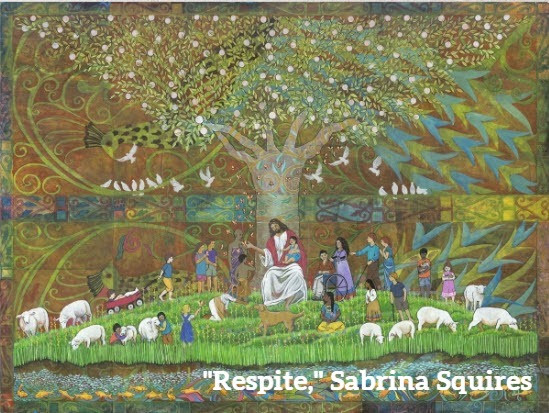
Featured Visual Artist
Sabrina Squires
“Layers are a theme in my work, which begins with a layer of altered National Geographic pages and builds through coats of ink, charcoal, and acrylic paint. I discovered this technique during a college assignment and fell in love with the way mixed media interacted with paper. Mixed media allow me to explore the vibrant hues, varying textures, and organic lines found in nature. I am an avid backpacker and love to immerse myself in the beauty found in the mountains. The symbols of nature and the formal elements of art become vehicles through which I can explore spiritual concepts, whether simple or complex.”