One of the great evolutionary leaps forward for humankind (and for all life on Earth more broadly) was the emergence of modern “scientific method” throughout the seventeenth century in Europe. Human societies around the world had been engaged in various kinds of experimental interactions with the wider world before then, of course, and often with great results. But I’m thinking especially of the legacy of figures like Nichoals Copernicus (who paved the way in the sixteenth century), Francis Bacon, and Isaac Newton. They formalized a method that featured careful observation, collecting quantifiable data, and applying rigorous forms of deductive reasoning to empirical investigations. The world-changing results ranged from new modes of public hygiene and the development of vaccines, to revolutions in technology, transportation, and environmental stewardship.
All the many advances rightly attributable to scientific method also came with many unfortunate consequences as well—global warming, ecological degradation, and the invention of weapons of mass destruction, to name just a few. But I’m reflecting right now on a slightly more abstract consequence of modern science that seems inherent to the method itself. Simply put, it perpetuates the old aphorism that “seeing is believing.” Or more broadly: what counts as “real” is what can be measured—and nothing else. This reduction of the “real world” to quantifiable data makes some of the things that matter the most to us seem “less real,” like affection and love, or art and beauty, or wonder and awe.
Modern Western society has lived with a dualistic view of reality for quite some time now, due in part to this approach to science, and which has consequences for our lives of religious faith. This modern view of the world tends to separate the “material” and the “spiritual,” a separation that shows up in all sorts of dualistic assumptions: the division between “body and soul,” or between “earth and heaven,” or between “human and divine.” These distinctions still haunt our liturgies and prayers, as well as our interpretations of even the most familiar biblical stories. It’s also a bit ironic to make these distinctions when every Sunday we affirm, in the words of the Nicene Creed, that God is the “maker of heaven and earth, of all that is, seen and unseen.”
Modern science itself has evolved from supposing that only the visibly tangible qualifies as “real.” Realizing that many realities fall outside the range of our visual acuity (human vision engages with only a small portion of the light spectrum) has led to the invention of tools to help us “see the unseen,” and today’s scientists investigate all sorts of phenomena that human beings had no idea even existed just a century ago, from teeny tiny electrons to massive black holes in the Universe. Some rich and even mind-bending suppositions emerge from all this: not everything that is “real” is necessarily measurable; some “real” things might be measurable but we don’t have the tools yet to measure them; things that we can measure might interact with other measurable things but the interaction itself is not measurable (or maybe it is but not yet).
Expanding what counts as “real” in our scientific world carries a host of implications for our lives of Christian faith. Consider, for example, the wind. We can’t see it, but we can certainly feel it, and often hear it, and there are ways to measure its force. It turns out that the air itself—which, when moving, we call “wind”—is full of physical particles and all sorts of material bits which we cannot see with the naked eye; or perhaps better put, we can most certainly see the effects of the wind, whether in the dancing leaves of a tree, or by kicking up dust, or blowing shingles from rooftops. The wind is a material presence, in other words, even when we can’t see it, and this is a wonderful reminder for our celebration of Pentecost this coming Sunday. The gift of the Holy Spirit would seem like one of those unmeasurable realities that defy modern science, but let’s not forget that biblical writers used the analogy of the wind to evoke the presence of God’s Spirit—indeed, the word in ancient Hebrew and in Greek that we see translated in the Bible as “spirit” can also be translated as “breath” or “wind.” (The most familiar example of this can be found in the first two verses of the Bible: In the beginning…a mighty wind [or the breath of God, the divine Spirit] swept over the face of the waters.)
The biblical readings for Pentecost this year offer a rich array of images for that divine Spirit among us. Let’s be sure to notice that the story from John’s account of the Gospel features the risen Jesus who breathes on his disciples to give them the gift of the Spirit. First-century readers of this story would have understood that divine breath as a material force—like a breeze—which enters the body and fills people with God’s presence. The reading from Paul’s first letter to the Corinthians portrays the results of that indwelling of the Spirit. Even if we cannot see the Spirit itself, we can identify and name the effects of the Spirit’s presence: we become members of Christ’s own body with the gifts of wisdom and knowledge, faith and healing, discernment and interpretation, and—in Paul’s famous thirteenth chapter of this same letter—the gift especially of love.
As we celebrate the great feast of Pentecost and the gift of the Holy Spirit this week, I would invite us to consider how we greet each other, the handshakes or hugs we exchange, the prayers we speak for a world in pain, and the simple meal of bread and wine we share at the Table as tangible signs of that Spirit moving among us—all of these and more are ways to make the unseen seen.
Dates and Notices
- The Feast of Pentecost is this Sunday, May 24! We will have one worship service only that day (at 10:15)—wear something red! We will also take our annual parish photograph immediately after the liturgy and everyone is urged to stay for the photo!
- Christian Neighbors, the shared outreach ministry of Saugatuck-Douglas churches, and to which All Saints’ Parish makes a monthly contribution, conducts special “drives” during the year. This month, they are collecting cereal—which is a great snack for children to have after they come home from school, and is a great help to parents! Please bring some boxes of cereal to church this month (of any kind!) or you can write a check to All Saints’ (with “Christian Neighbors” on the memo line).
- The Third Annual Jazz for Justice street party to kick off LGBTQ Pride Month is scheduled for Friday evening, June 5! Mark your calendars as we welcome back the Holland Concert Jazz Orchestra from 5:30—9:00 p.m. We will close Grand Street in front of the parish hall lawn; food trucks, beer, wine, and soft drinks will be available, as well as dessert! Invite your friends and neighbors! This is a wonderful celebration and opportunity to stand (musically) in solidarity with all of our lesbian, gay, bisexual, and transgender friends and neighbors! We also have yard signs to help promote the event—you can pick one up for your own yard at church!
- Scripture and Sexuality is a topic that tends to shape conversations (and sometimes confrontations) at LGBT Pride festivals. As people of faith, we should always be prepared to give sound religious and spiritual reasons for our unqualified embrace and welcome of LGBT people—including our approach to the Bible in that welcoming posture. On Sunday, June 14, following the 10:15 liturgy, we will review ways of talking about the Bible for the sake of welcoming LGBT people, including strategies for engaging with people who object to such postures of Gospel welcome.
I’ve been thinking and writing (and preaching) a lot lately about symbols, and some of the complexities involved when reading sacred stories and praying liturgical texts together. One could quite rightly note that religion itself is entirely a system of interconnected symbols. The most recognizable—and for many, the primary—symbol of Christianity is the cross, which seems at first glance to be a fairly simple reminder of how Jesus was killed. But like all symbols, the cross stands for more than a historical event; the cross also signals sacrifice, perhaps atonement, a moment of profound solidarity, even the hope of resurrection and new life. Just this one example of a symbol reminds us that every symbol always points to something or evokes someone or gestures toward some place. The complexity grows when multiple symbols are networked and form a system of ideas and invitations.
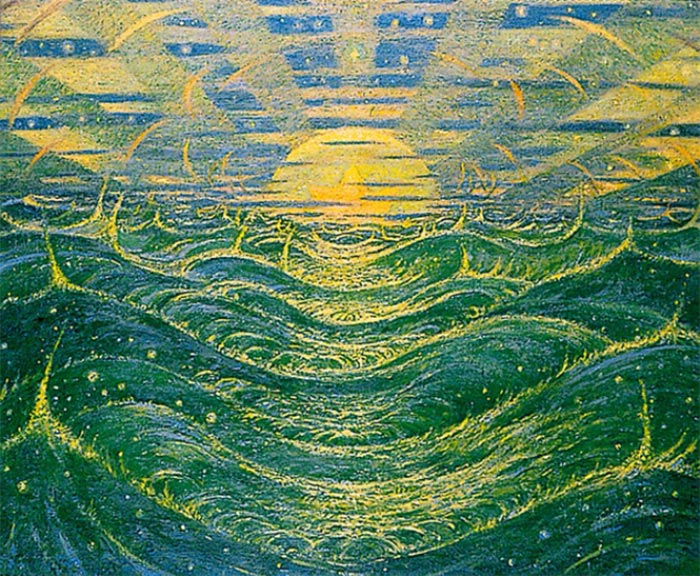
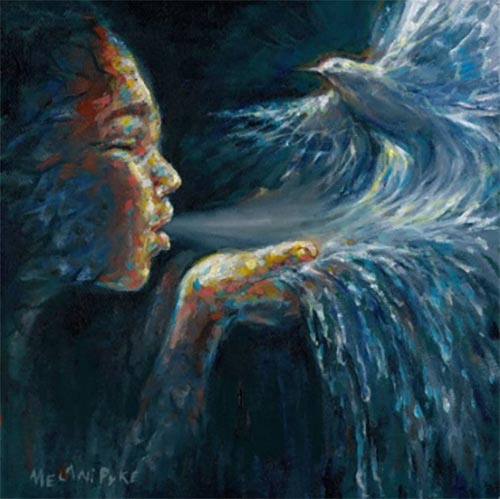
One of the challenges I face, especially in seasons rich and full of a wide range of symbols—like Lent, Easter, and Pentecost!—is discerning where best to land in any given week. We can’t engage with all the symbols all the time, and Sander Owens, our parish musician, faces a similar challenge in selecting hymns and sorting music for the choir. This coming Sunday is a great illustration of this; as we celebrate Pentecost, we will renew our Baptismal Covenant as a way to remember the kind of life the gift of the Holy Spirit equips us to live in the wider world. As we do so, we add the symbol of water to the symbol of wind (not to mention the symbol of fire!) to our celebration. The image below from visual artist Melani Pyke captures beautifully the rich complexity of multiple symbols intertwining in a single celebration—even the title of her piece evokes that richness! As I try to remind myself each week, I would also encourage you to discern which symbol on any given feast day might be especially intriguing or attractive to you at that moment: as a given symbol draws your attention, it might be inviting you deeper into the infinite mystery of the living God in a new and fresh way; may it be so for each of us this week at the Font and the Table!
Fr. Jay
A Community of Care
Please let us know how we may pray for you—concerns as well as celebrations—and other requests you may have as we strengthen our bonds of care and compassion with each other here in western Michigan and with those around the world in need of prayer.
Notices:
- Mike Mulcahy has moved into an assisted living situation for memory care; please keep Mike and Chris Seidel in your prayers during this time of transition.
Prayer Requests
- The United States of America—for a restoration of peace and for a renewed commitment to the common good; for an end to systemic racism and violence; for social and economic justice; for a courageous engagement with ecological renewal and healing.
- For an end to violence and a lasting peace with justice throughout the world—in the Middle East (especially in Iran, the nations of the Gulf region, and still also Gaza and the West Bank), and in Ukraine.
- The mission and shared ministry of this parish, for pastoral insight and ministerial discernment for the clergy and lay leaders, especially the Vestry and our various Ministry Teams.
- For the Bishop Search Committee of this Diocese of the Great Lakes, for divine guidance in preparing a slate of candidates, and for discernment among all those who might feel called to serve.
- Lynn, Mary Ryder’s cousin.
- Katelyn, for comfort and healing.
- Holly Quarles, for courage and healing.
- Mary Saba, for healing.
- Frank Lindsay, for healing.
- Sky and Dale Ann Suydam, for resilience and courage.
- Kevin Martin, for healing and renewed strength.
- Susan Gaunt, for renewed strength and healing.
- Luca Gillespie-Reeves, for comfort and healing.
- Ruth Vanden Bosch, for resilience and healing.
- Mike Mulcahy and Chris Seidel, for comfort and strength.
Special Occasions in May
Do we have your special occasions on file? Would you like to prayerfully celebrate your baptismal anniversary? Ordination anniversary? Let us know what you would like us to remember with you and we’ll post it!
Birthdays – May
Mike Mulcahy 05/07, Margaret Mason 05/13, Scott Morrow 05/13, John McMahon 05/15, Mary Ryder 05/21, Jane Underwood 05/21, Chris Seidel 05/22, James Lamb 05/25, Bub (Edward) Pazier 05/25, Peter McGregor 5/27, Kathryn (Kitty) Beecken 05/28
Wedding Anniversaries – May
Steve and Janice Williford 05/08, Mike and Heidi Campbell 05/10